Thrust Allocation v2
DP capability in the browser
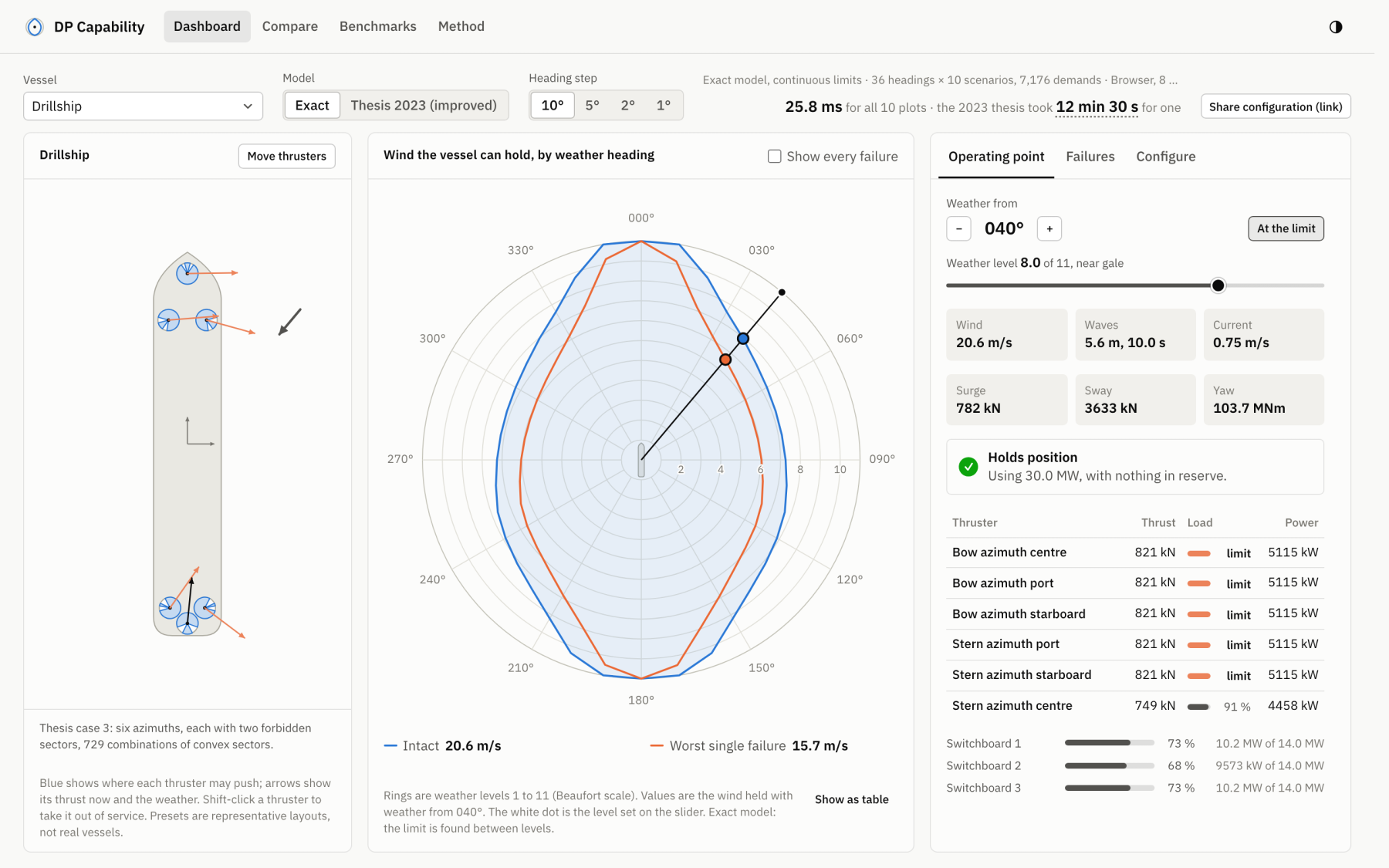
How much weather can a dynamically positioned vessel hold, from every direction, intact and after any single failure? The 2023 version answered that with an SQP solver in Python and took up to twelve minutes per plot. This one answers it in milliseconds, in the browser, with exact thruster regions and every answer bounded from both sides. The blog post has the story and the numbers.
Highlights
exact real circles, sectors and rudder curves instead of 24-sided polygonscertified every limit sits between an explicit thruster allocation and a support-function boundsectors branch and bound over forbidden sectors, equal to trying all 729 combinations on the drillship without visiting themfailures every single switchboard and thruster failure, and their worst-case envelope, computed on every changepower true power, , minimised as a conic programlive drag thrusters around the hull and the plot follows, 10 to 30 ms per full analysiscompare up to four plots on one set of axes, including the 2023 model against the exact one3D the attainable force set, with the weather load running out of it
Numbers
Thesis Case 3, the drillship with every sector combination: 12 min 30 s in the thesis, 45.9 s for the same Python with one environment variable fixed, 541 µs for the same model on the new engine. The new engine agrees with the old one at 705 of 720 recorded headings; at the other 15 the old solver gave up on feasible problems.
Built with
Rust for the engine, compiled to WebAssembly and run in a pool of web workers, with Clarabel for the conic programs. Vue 3 and TypeScript, three.js for the 3D view, Playwright for the end-to-end tests, Firebase Hosting.